uae-corporatetaxderegistration.com

Corporate Tax De-Registration in JAFZA Free Zone – Complete Guide
Complete guide to Corporate Tax de-registration in JAFZA Free Zone. Learn eligibility, FTA process, required documents, timelines, and compliance rules.
Gupta Group International
12/29/20253 min read


Corporate Tax De-Registration in JAFZA Free Zone – Complete Guide
Corporate Tax De-Registration in JAFZA Free Zone –Complete Guide
The introduction of UAE Corporate Tax has brought significant compliance obligations for businesses operating across the UAE, including those in the Jebel Ali Free Zone Authority (JAFZA). While JAFZA companies benefit from a robust free zone framework and potential 0% Corporate Tax under qualifying conditions, Corporate Tax registration and de-registration remain mandatory legal requirements.
This guide explains when Corporate Tax de-registration is required in JAFZA, the eligibility criteria, the de-registration process, timelines, penalties, and key compliance considerations for JAFZA Free Zone companies.
Understanding Corporate Tax De-Registration in JAFZA
Corporate Tax de-registration refers to the formal removal of a company from the UAE Corporate Tax register maintained by the Federal Tax Authority (FTA) through the EmaraTax portal.
A JAFZA company remains liable for Corporate Tax compliance until the FTA officially approves de-registration, regardless of:
Business inactivity
License expiry
Free zone status
Failure to de-register on time may result in administrative penalties, even if the company is no longer operational.
Corporate Tax Applicability for JAFZA Companies
Under Federal Decree-Law No. 47 of 2022, JAFZA entities are considered taxable persons once registered for Corporate Tax.
While many JAFZA companies may qualify as Qualifying Free Zone Persons (QFZP) and benefit from a 0% Corporate Tax rate, this does not eliminate compliance obligations, including:
Registration
Return filing
De-registration when applicable
Who Can Apply for Corporate Tax De-Registration in JAFZA?
A JAFZA Free Zone company may apply for Corporate Tax de-registration if:
The company has ceased all business activities in the UAE
The entity has been liquidated or struck off by JAFZA
The JAFZA license has been cancelled and the business is permanently closed
The business is no longer required to be registered under UAE Corporate Tax law
A dormant JAFZA company with no income is being formally closed
Important Note:
Even JAFZA companies enjoying QFZP status must apply for Corporate Tax de-registration if the business is closed or liquidated.
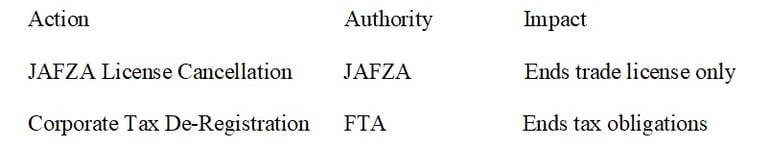
Corporate Tax De-Registration vs JAFZA License Cancellation
One of the most common misconceptions is that JAFZA license cancellation automatically cancels Corporate Tax registration. This is incorrect.
If Corporate Tax de-registration is not completed separately:
Filing obligations continue
FTA penalties may apply
Compliance notices may be issued
Key Conditions Before Applying for De-Registration
Before submitting a Corporate Tax de-registration application, JAFZA companies must ensure:
All Corporate Tax returns up to the cessation date are filed
Any outstanding Corporate Tax liabilities or penalties are settled
Final financial statements are completed up to the closure date
JAFZA license cancellation or liquidation is initiated or completed
The FTA may reject or delay applications if compliance requirements are incomplete.
Corporate Tax De-Registration Process for JAFZA Companies
The de-registration process is completed via the FTA EmaraTax portal and generally involves the following steps:
Step 1: Confirm Business Cessation
Ensure that all commercial activities have permanently stopped and the cessation date is clearly defined.
Step 2: Prepare Required Documents
Commonly required documents include:
JAFZA license cancellation or liquidation certificate
Final financial statements
Proof of business cessation date
Step 3: Submit De-Registration Application
Submit the Corporate Tax de-registration request through EmaraTax along with all supporting documentation.
Step 4: FTA Review and Clarifications
The FTA may request additional information or corrections before approval.
Step 5: Approval and Tax Account Closure
Once approved, the Corporate Tax registration is officially cancelled.
Timeline for Corporate Tax De-Registration in JAFZA
JAFZA companies are generally required to apply for Corporate Tax de-registration within three months from:
Business cessation
License cancellation
Completion of liquidation
Late applications may result in administrative penalties, even if no Corporate Tax is payable.
Corporate Tax De-Registration During JAFZA Liquidation
During liquidation, JAFZA companies must:
File a final Corporate Tax return
Declare any taxable income or losses
Settle outstanding liabilities
Submit liquidation and financial documentation to the FTA
The FTA will only approve de-registration once it confirms full tax compliance.
Penalties for Late or Incorrect De-Registration
The FTA may impose penalties for:
Failure to apply for de-registration within the required timeframe
Failure to submit final Corporate Tax returns
Providing incorrect or incomplete information
Ignoring FTA notifications
Penalties apply even to zero-income or QFZP-status companies.
Common Mistakes JAFZA Companies Should Avoid
Assuming dormant companies do not require de-registration
Believing license cancellation completes tax closure
Missing final return filing deadlines
Using incorrect cessation dates
Submitting incomplete documents on EmaraTax
These errors often lead to delays, rejections, or fines.
Why Professional Support Is Important
Corporate Tax de-registration in JAFZA involves:
Regulatory coordination between JAFZA and FTA
Accurate financial and tax reporting
Strict timelines and documentation requirements
Professional assistance helps ensure:
Correct sequencing of closure steps
Faster FTA approval
Avoidance of penalties
Complete compliance closure
© 2026 uae-corporatetaxderegistration.com
